Download Image
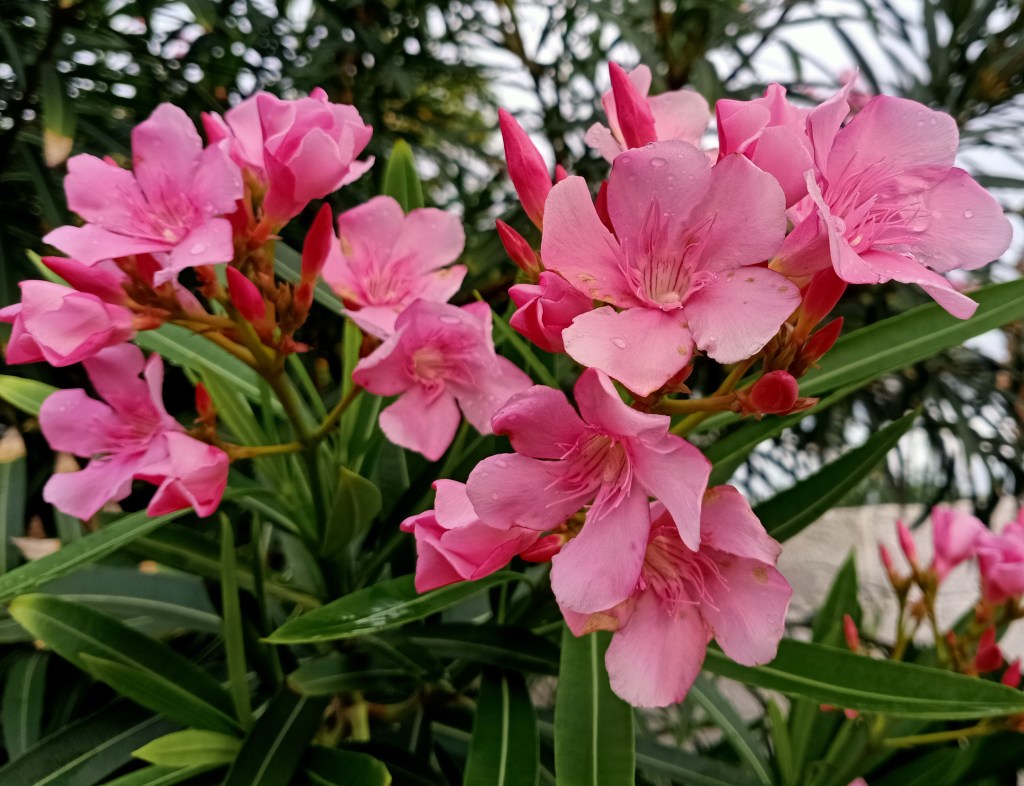
Nerium oleander, commonly referred to as oleander or Nerium Pink, is a type of tree that produces flowers in a variety of colors. Although they belong to the same species, their blooms differ in shades. This tree is known to be toxic; thus, no part of it should be ingested. Nevertheless, in Ayurveda, it is utilized for treating external ailments. It is classified under the Apocynaceae family and goes by the scientific designation Nerium oleander. Despite its toxicity, this plant is often cultivated in households and temples for ornamental purposes. The flowers are offered during prayers to deities.
Flowers of Nerium oleander hold significant importance in worshipping Shiva. The pink blossoms are considered sacred by devotees of Lord Shiva. According to the Puranas, offering these flowers while praying to Shiva yields the benefits equivalent to performing ten Asaumyadha Yogas. It is also mentioned that those who present eight Nerium Pink flowers during worship are believed to reach Kailash, which explains why this tree is cultivated in many homes for Shiva pujas.
Characteristics of Nerium Pink
Nerium oleander typically grows as a shrub, reaching heights between three and twenty feet, with most varieties averaging eight to twelve feet tall. The growth rate is rapid, often increasing one to two feet each year. Its trunk is robust, covered with thick, leathery, dark gray-green leaves that are generally narrow, measuring around four to six inches in length. Oleander produces flowers in various colors, including yellow, pink, white, light orange, and red, which are often found in clusters at the tips of the branches. The majority of oleander plants have fragrant blooms. The fruit produced is known as a capsule, which carries numerous fluffy seeds.
Impact
The oleander tree contains two harmful substances called oleandrin, which severely affect the human nervous system. Consuming it in significant amounts can lead to symptoms such as vomiting, diarrhea, and abdominal discomfort, which can be fatal. Caution is essential, especially around children, as consuming any part of this tree poses serious risks to them. However, extracts from the plant have been used successfully in cancer treatments.
Did you see that even though this tree is dangerous, some of its ingredients are used in cancer treatment? It is said that there are a few things like this on this earth. These are not the only ones; there are many things that we do not know. So it is better to share what we know with others and to keep learning about what we do not know.
Let’s explore its applications in Ayurvedic medicine
After handling any part of Nerium oleander, it is crucial to wash your hands thoroughly, considering its high toxicity. The leaves are utilized to relieve knee pain. By grinding these leaves into a paste, mixing it with coconut oil, and applying it to the knee area, one can alleviate discomfort. For scorpion or snake stings, the tree’s roots can be crushed into a paste and applied to the area of the bite, helping mitigate the effects of the venom.
Additionally, if you’re experiencing swelling in the penis, rubbing it with the paste made from the leaves’ saffron may reduce the inflammation. For pest issues within the home, creating a decoction from the leaves of Nerium Pink and sprinkling it in various corners of the house will help drive insects away.
Final thoughts
The Nerium Pink tree is toxic. Inform your kids about this. This is important because if these trees are nearby, kids might play with their blooms. If ingested, they can be very harmful and could even cause death. Anyone using these plants for medicinal reasons should seek guidance from professionals. When planting these trees close to your house, ensure that children do not access them. Additionally, do not leave them unsupervised.
Read This
- About marigold flowers and the history of cultivation guide
- History of rose flowers: growing, cultivation and variety of garden
- Rakhi Purnima special Raksha Bandhan Joy and Love between brother and sister
- Great History of Mother’s Day: Why It’s Celebrated on May 2
- The history behind a girl’s Father’s Day: Wishes and celebrations
- Understanding Ramadan: Its Significance and fasting